"Happy 250th to This Land©"
Release Date: June 25th, 2026
Lyrics by M. S. McKenzie | Performed by Songs Across America, Protected by Copyright
Streaming Services Music Link for Version I
~ Associated State Links ~
[ ME Home Pg. | ME Gallery Pg. | ME Attractions Pg. | Best Small Towns | Best Small Cities ]
[ NC Home Pg. | NC Gallery Pg. | NC Attractions Pg. | Best Small Towns | Best Small Cities ]
[ TN Home Pg. | TN Gallery Pg. | TN Attractions Pg. | Best Small Towns | Best Small Cities ]
[ AZ Home Pg. | AZ Gallery Pg. | AZ Attractions Pg. | Best Small Towns | Best Small Cities ]
[ WY Home Pg. | WY Gallery Pg. | WY Attractions Pg. | Best Small Towns | Best Small Cities ]
[ WA Home Pg. | WA Gallery Pg. | WA Attractions Pg. | Best Small Towns | Best Small Cities ]
"Happy 250th to This Land"
Why I Wrote This Song
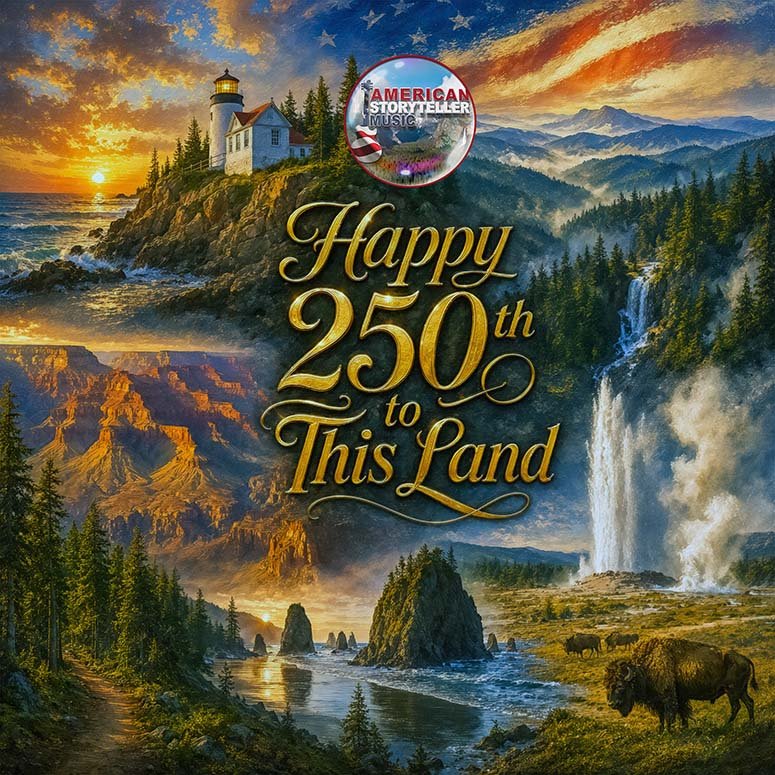
I wrote "Happy 250th to This Land" as a birthday song for the whole country, and I built it the way you'd build a toast, moving from coast to coast through landscapes rather than history, because I wanted the celebration to feel geographic and physical rather than abstract. Acadia's rocky shore, the misty Smokies, the Grand Canyon's painted depths, Yellowstone's sleeping geysers, each verse is really just a different way of saying the same thing, that 250 years is a long time for a country this vast and varied to still be standing together.
The story behind the song is in the chorus's insistence on unity across enormous distance, from Atlantic to Pacific, we are one in unity. I didn't want that line to feel like a slogan. I wanted the specific landscapes preceding it to earn it, so that by the time you hear "we are one" you've already traveled thousands of miles of genuinely different country to get there. The bridge, we honor our past with love as our guiding light, was important to me because a 250th birthday deserves gratitude more than triumphalism.
Songs Across America exists because I believe this country's geography and its unity are the same story told two different ways, and this is the song where I said that most directly. I hope it gets played at actual anniversary celebrations, and that it reminds people how much genuinely different land and life this one country manages to hold together.
Genre:
Sweeping, anthemic tribute song built as a coast-to-coast travelogue, moving through iconic American landscapes toward a soaring, unifying chorus meant for large group singing at anniversary celebrations.
Theme:
National milestone and gratitude, unity across vast geographic diversity, reverence for the land as a stand-in for reverence for the country, and honoring the past without triumphalism.
Primary Subject:
The United States on its 250th anniversary, traveled through its iconic landscapes from Acadia and the Great Smoky Mountains to the Grand Canyon and Yellowstone.
Mood:
Celebratory, reverent, and unifying throughout, warming into gratitude by the bridge.
Core Message:
A quarter-millennium of a country this vast staying together is worth genuine gratitude rather than routine celebration. Unity across such different landscapes and lives isn't a slogan, it's an ongoing achievement earned across every mile between one coast and the other.
Original Song Lyrics: Written by M. S. McKenzie, All Rights Reserved
[Verse 1]
In Acadia's embrace, where the sun first kisses the land
The ocean whispers softly and waves caress the sand
Beneath the endless sky, where eagles dare to soar
Nature's song begins, echoing across the rocky shore
[Chorus]
So happy two fiftieth, to this land that's still free
From Atlantic to Pacific, we are one in unity
We all rejoice in this land we proudly stand
Together we rise...
...Hand in hand...
[Verse 2]
In the Great Smokies' gentle fog, where ancient hills reside
A symphony of waterfalls sings a song they cannot hide
Through the misty mornings, where shadows softly creep
Nature tells her story in the secrets that she keeps
[Breakdown]
(Instrumental saxophone solo)
[Chorus]
So happy two fiftieth, to this land that's still free
From Atlantic to Pacific, we are one in unity
We all rejoice in this land we proudly stand
Together we rise...
...Hand in hand...
[Verse 3]
Into Grand Canyon's depths, where silence holds its own
A timeless masterpiece unfolds, in the earth it's shown
Painted rocks of splendor, under skies so grand
Nature's finest canvas, carved by an unseen hand
[Bridge]
In this land we cherish, where dreams take flight
We honor our past with love as our guiding light
[Verse 4]
Yellowstone slumbers, where geysers touch the sky
Bison thunder across the plains, under watchful eyes
And worlds of wonder wait in each meadow's dance
Where nature's vibrant palette lives in every glance
[Final Chorus: choir of back-up singers]
So happy two fiftieth, to this land that's still free
From Atlantic to Pacific, we are one in unity
We all rejoice in this land we proudly stand
Together we rise...
...Hand in hand...
[Verse 5]
In the Olympics' shadow, where temperate rainforests rise
And snow-covered mountain peaks scrape the skies
The windswept Pacific carves away at the land
Where spruce-covered islands and sea stacks stand
[Outro: Instrumental to fade]
Song Description
"Happy 250th to This Land" is a sweeping, celebratory tribute to the United States on the occasion of its 250th anniversary. Rather than focusing primarily on political history, monuments, or military achievement, the song honors the nation through the grandeur of its natural landscapes. It presents America as a vast, living work of art, stretching from the rocky shores of Maine to the rainforests and sea stacks of the Pacific Northwest.
The song unfolds like a musical journey across the country, visiting five iconic national parks: Acadia, Great Smoky Mountains, Grand Canyon, Yellowstone, and Olympic. Each location represents a different region, atmosphere, and expression of the American wilderness. Together, these landscapes form a portrait of a country united not only by borders and history, but also by shared beauty, wonder, and responsibility.
Narrative and Thematic Overview
The opening verse begins in Acadia National Park, where the first sunlight reaches the Atlantic coast. The imagery is quiet and reverent: waves move gently against the shore, eagles soar beneath an open sky, and the rocky coastline seems to awaken with the dawn. This eastern beginning establishes the song as a journey from Atlantic to Pacific while also introducing nature as its central voice.
The chorus expands the perspective from one landscape to the entire nation. "From Atlantic to Pacific" becomes both a geographic statement and a symbol of collective identity. The phrases "we are one in unity" and "together we rise, hand in hand" emphasize cooperation and shared belonging. The celebration is not presented as belonging to one region, group, or ideology. It is an invitation for people across the country to stand together and recognize what they share.
The second verse moves south into Great Smoky Mountains National Park. Here, the atmosphere becomes softer, more mysterious, and more introspective. Ancient hills, drifting fog, hidden shadows, and singing waterfalls create the feeling of a landscape holding centuries of memory. The line about nature keeping secrets suggests that the land contains stories older and deeper than any written history.
An instrumental saxophone solo follows, offering a moment of emotional release and reflection. It allows the music to speak without words, bridging the misty stillness of the Smokies with the immense scale of the Grand Canyon.
The third verse enters the Grand Canyon, where silence becomes almost sacred. The canyon is described as a timeless masterpiece revealed through painted rock, depth, and open sky. The phrase "nature's finest canvas" reinforces the song's recurring idea that the American landscape is itself a form of art. The canyon represents time, endurance, and the immense forces that shaped the continent long before the nation existed.
The bridge briefly shifts from scenery to national reflection. "In this land we cherish, where dreams take flight" acknowledges the aspirational character of the United States, while "we honor our past with love as our guiding light" encourages remembrance without bitterness. The emphasis on love suggests that patriotism is strongest when it includes compassion, humility, and a commitment to unity.
The fourth verse moves into Yellowstone National Park, bringing greater motion and energy. Geysers rise into the sky, bison thunder across open plains, and meadows seem alive with color and movement. Yellowstone becomes a symbol of untamed vitality. Its geothermal power and abundant wildlife remind the listener that the country's natural heritage is dynamic, fragile, and worthy of protection.
The final chorus broadens into a choir of supporting voices, giving the celebration a communal, almost ceremonial quality. The additional voices reinforce the song's central message: the nation's anniversary is something shared. The choir transforms the chorus from a personal declaration into a collective affirmation.
The final verse reaches Olympic National Park and the Pacific coast. Temperate rainforests, snow-covered mountains, windswept shorelines, forested islands, and sea stacks bring the cross-country journey to its western conclusion. The imagery combines wilderness, ocean, and mountain terrain in a final display of geographic diversity. Ending in the Olympics completes the song's movement from sunrise on the Atlantic to the rugged edge of the Pacific.
Central Themes
At its heart, "Happy 250th to This Land" is a song about unity, gratitude, and national stewardship. It celebrates freedom, but it does so through the land itself rather than through political rhetoric. The national parks become symbols of continuity: they existed before the present generation and, with care, can remain long after it.
The song also presents patriotism as an inclusive emotional bond. Its repeated image of people rising "hand in hand" suggests that national strength is created through cooperation rather than division. The lyrics acknowledge the past while looking toward the future with hope.
Another important theme is the relationship between identity and place. Each park has its own character, yet all belong to the same national landscape. Acadia's rocky coast, the Smokies' mist, the Grand Canyon's layered stone, Yellowstone's geysers, and Olympic's rainforests are radically different, but together they form a unified portrait. This geographic diversity becomes a metaphor for the diversity of the country itself.
Imagery and Symbolism
The song is filled with natural imagery that gives each verse a distinct visual and emotional tone:
Acadia represents beginnings, sunrise, and the eastern edge of the nation.
Great Smoky Mountains represents memory, mystery, and ancient continuity.
Grand Canyon represents time, scale, silence, and geological wonder.
Yellowstone represents energy, wildlife, movement, and untamed power.
Olympic represents the western frontier, wilderness, and the meeting of forest, mountain, and sea.
The journey from Atlantic to Pacific provides the song with a clear structural arc. It allows the listener to experience the country as a connected landscape while reinforcing the chorus's message of national unity.
Musical and Emotional Character
Musically, the song supports a broad, uplifting arrangement with a cinematic Americana character. It could begin gently, with acoustic guitar, piano, atmospheric pads, or soft orchestral textures suggesting dawn over Acadia. The verses would benefit from spacious instrumentation that allows the landscape imagery to remain clear.
The chorus should expand with fuller percussion, warm strings, electric guitar, and layered harmonies. It should feel celebratory without becoming overly martial or bombastic. The emotional tone is proud, hopeful, and inclusive rather than aggressive.
The saxophone breakdown adds warmth and individuality. A lyrical, expressive solo could evoke both reflection and freedom, providing contrast to the more expansive vocal sections.
As the song progresses, the arrangement could gradually grow in scale. Yellowstone's verse may introduce stronger drums, deeper bass, and rhythmic movement to reflect the force of the geysers and bison. The final chorus, supported by a choir, should feel like the emotional summit of the song: wide, communal, and uplifting.
After the final Olympic verse, the instrumental outro can slowly fade with oceanic ambience, sustained strings, guitar, piano, or distant saxophone. This would leave the listener with the feeling that the journey continues beyond the final lyric.
Overall Meaning
"Happy 250th to This Land" is both a birthday song and a national landscape anthem. It celebrates two and a half centuries of American history while reminding listeners that the country's identity is inseparable from its mountains, forests, canyons, plains, wildlife, and coastlines.
Its message is ultimately one of gratitude and shared responsibility. The nation is portrayed not simply as something inherited, but as something entrusted to each generation. By honoring the land, remembering the past, and standing together, the song suggests that Americans can carry the country forward with unity.






.jpg)






































.jpg)