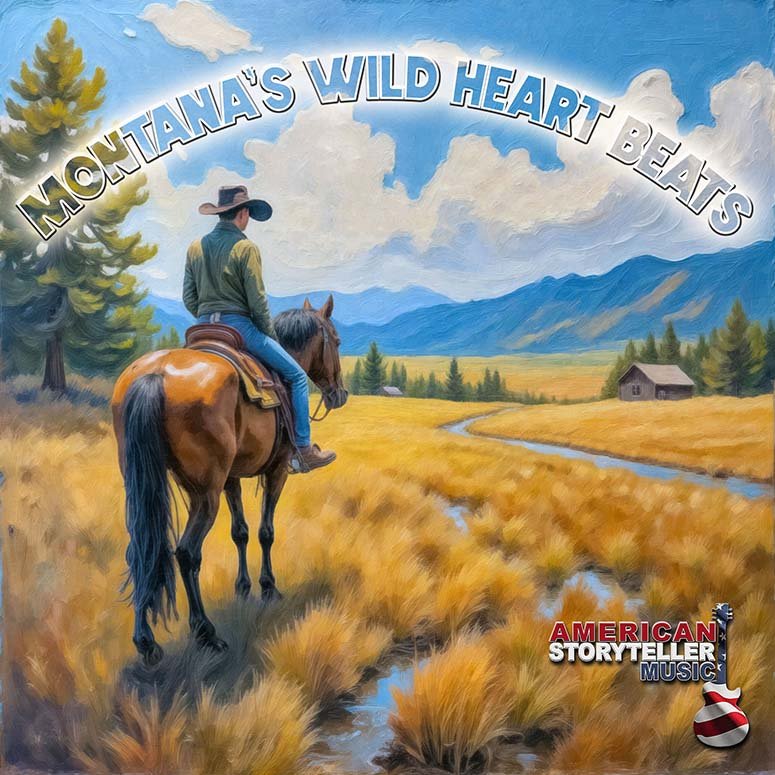
"Montana's Wild Heart Beats©"
Lyrics by M. S. McKenzie (Unless Otherwise Noted) | Music Performed by Songs Across America or American Storyteller Music, All Songs Are Protected by Copyright
~ Associated State Links ~
"Montana's Wild Heart Beats"
[Verse 1]
Morning spills on Flathead's shore
Like liquid gold on nature's floor
While Northern Rockies touch the dawn
Where wild dreams are carved in stone
Through Bitterroots dressed silver-white
Their peaks ablaze in morning light
These ancient guardians still stand
Protecting Montana's sacred land
[Chorus]
Montana's wild heart beats
In rhythms old as stone
Where sky and mountain meet
In colors yet unknown
And freedom still runs deep
In places we call home
[Verse 2]
Up where Glacier meets the stars
And mountain goats roam near and far
Past Hidden Lake's emerald gleam
Through valleys carved by ice and dream
While Going-to-the-Sun Road climbs
Through curtains of forgotten time
Here grizzlies walk in fields of gold
Where heaven's secrets still unfold
[Verse 3]
Absaroka's morning crown
Wears clouds like jewels tumbling down
Where elk herds cross the silver streams
And wolves still chase their ancient dreams
Past Yellowstone's great northern gate
Where bison roads still wind and wait
Through canyons deep as memory
Where wild things still run proud and free
[Verse 4]
Beneath Big Sky's endless dome
Where prairie winds have made their home
While Missouri's waters shine
Like ribbons through the grand design
Past painted buttes at break of day
Where falcon shadows dance and sway
These plains still hold their mystery
In waves of grass from sea to sea
[Chorus]
Montana's wild heart beats
In rhythms old as stone
Where sky and mountain meet
In colors yet unknown
And freedom still runs deep
In places we call home
[Bridge]
Montana paints her stories in the sky
Where eagles dance and wild winds fly
Her spirit runs forever free
Through mountain peaks and prairie sea
"Montana's Wild Heart Beats" is a lyrical and atmospheric celebration of Montana's living wilderness, immense skies, ancient mountains, open grasslands, and enduring sense of freedom. While the song travels through recognizable places such as Flathead Lake, the Northern Rockies, the Bitterroot Mountains, Glacier National Park, the Absaroka Range, Yellowstone's northern entrance, the Missouri River, and the eastern plains, its deeper focus is not simply geography. It presents Montana as a living presence with a pulse, a memory, and a spirit that continues to move through its landscapes.
The central metaphor of the song is contained in its title and chorus: Montana possesses a "wild heart" that beats in rhythms older than human history. That heartbeat can be heard in mountain streams, migrating wildlife, sweeping prairie winds, glacial valleys, shifting clouds, and rivers crossing the plains. Rather than portraying the state as a collection of scenic landmarks, the song treats every region as part of one interconnected natural body.
The first verse begins at Flathead Lake as morning light spreads across the water. "Morning spills on Flathead's shore" gives the sunrise movement and abundance, while the comparison to liquid gold transforms the lake and surrounding land into something luminous and almost sacred. The phrase "nature's floor" creates the impression of sunlight being poured across the physical surface of the world.
Flathead Lake serves as an ideal opening location because its broad waters reflect both the mountains and Montana's enormous sky. The sunrise becomes a meeting point between water, land, and atmosphere, immediately establishing the song's interest in natural harmony. The scene feels quiet and expansive, as though the landscape is awakening before the human world has fully begun its day.
The Northern Rockies are described as touching the dawn, emphasizing their elevation and monumental scale. Their peaks appear to reach into the first light of morning, linking the solid permanence of stone with the constantly changing colors of the sky. The line "Where wild dreams are carved in stone" gives the mountains both physical and symbolic meaning. Their cliffs and ridges have been shaped by geological forces, but they also represent freedom, imagination, endurance, and the human desire to experience places beyond ordinary boundaries.
The Bitterroot Mountains continue this upward movement. Dressed in silver-white snow and illuminated by sunrise, they appear ceremonial and majestic. The snow becomes clothing, while the morning light causes the peaks to blaze. This personification makes the range feel alive, dignified, and watchful.
Calling the mountains "ancient guardians" reinforces their sense of permanence. They have stood through changing climates, cultures, migrations, conflicts, and generations of human settlement. The idea that they protect Montana's sacred land does not suggest literal guardianship, but rather the way mountains define, shelter, and symbolize the region. Their presence creates both a physical boundary and an emotional sense of continuity.
The use of the word "sacred" expresses reverence for the landscape without requiring a specific religious meaning. Montana's land is sacred because it contains deep ecological, cultural, historical, and personal value. It supports wildlife, preserves geological history, sustains communities, and offers people a powerful experience of space and belonging.
The chorus transforms the descriptive journey into a statement about Montana's deeper identity. "Montana's wild heart beats" suggests that beneath the stillness of mountains and plains there is constant movement. Rivers flow, winds travel, animals migrate, grasses bend, snow melts, and seasons continually reshape the land.
The heartbeat is said to move in "rhythms old as stone." This connects the living present to geological time. The rhythms of Montana existed long before roads, towns, or state borders. They are the rhythms of erosion, glaciation, migration, weather, reproduction, growth, fire, and renewal.
"Where sky and mountain meet" captures one of Montana's defining visual experiences. Peaks rise directly into broad heavens, and the great distance of the horizon can make the transition between land and sky seem especially dramatic. In changing weather and light, that meeting place produces colors that can feel entirely new.
The phrase "in colors yet unknown" adds wonder and possibility. No two Montana sunrises, sunsets, storms, or seasons are exactly alike. Mountain snow may turn silver, rose, violet, or gold, while prairie skies can shift from deep blue to fiery orange within minutes. The line suggests that nature still possesses the ability to surprise people with beauty they have never previously imagined.
The chorus's declaration that freedom "still runs deep" connects the landscape with an emotional and cultural ideal. Freedom is not portrayed primarily as political rhetoric. It is experienced through open space, distant horizons, wild animals, flowing water, and places where the natural world still appears larger than human development.
The final chorus line, "In places we call home," gives the song an intimate foundation. Montana's wilderness may be majestic and enormous, but it is also familiar to those who belong there. Home includes not only houses and communities but lakes, trails, valleys, ranchlands, mountain roads, and the recurring sight of the same ridgelines beneath changing skies.
The second verse moves into Glacier National Park, raising the song from the lake country into the alpine world. "Up where Glacier meets the stars" describes the park as a place so elevated and clear that the mountains seem to touch the night sky. The phrase gives Glacier an almost celestial quality.
Mountain goats appear as natural inhabitants of this high country. Their ability to move across steep cliffs and narrow ledges reflects the specialized life of the alpine environment. They help communicate the ruggedness of Glacier while also adding grace and animation to the landscape.
Hidden Lake is described through its emerald gleam. Alpine lakes frequently reflect the colors of surrounding vegetation, sky, minerals, and shifting sunlight. The word "gleam" suggests a brief, bright revelation, as though the lake appears like a jewel discovered among the mountains.
The valleys are said to have been carved by "ice and dream." Ice refers directly to the glaciers that sculpted Glacier National Park's valleys, basins, ridges, and cliffs. Dream introduces imagination and emotional response. The geology is real and ancient, but the landscape also feels dreamlike because of its scale, color, and dramatic form.
Going-to-the-Sun Road becomes a passage through both elevation and time. Its climb carries travelers from lower forests and valleys into alpine terrain, but the lyrics describe the journey as passing through "curtains of forgotten time." This image suggests that every bend in the road reveals another layer of geological history.
The curtains may also represent waterfalls, clouds, mist, snowfields, and the vertical walls of rock that briefly conceal and then reveal new views. The road does not simply cross the park; it feels like a route into an older world shaped by ice and stone.
Grizzly bears walking through "fields of gold" create one of the verse's most visually powerful scenes. The golden fields may be mountain meadows illuminated by sunlight or grasses changing color with the season. The contrast between the dark, powerful form of a grizzly and the brightness of the meadow gives the image cinematic force.
The line "Where heaven's secrets still unfold" preserves a sense of mystery. Glacier National Park may be mapped and visited, but it cannot be fully reduced to facts or photographs. Weather changes quickly, wildlife appears unpredictably, and every trail or viewpoint can reveal something different. The landscape continues to unfold rather than being completely understood.
The third verse shifts southward to the Absaroka Range and the Greater Yellowstone region. The Absarokas are crowned with morning clouds, which are compared to jewels tumbling down the peaks. This gives the clouds movement, color, and richness.
The mountains appear regal, but their crown is temporary and constantly changing. Wind reshapes the clouds, sunlight alters their color, and the peaks repeatedly emerge and disappear. This creates a contrast between the permanence of stone and the fleeting nature of atmosphere.
Elk crossing silver streams bring the landscape into motion. The streams reflect morning light while the elk follow routes shaped by water, forage, weather, and seasonal migration. The image presents wildlife as fully integrated into the physical geography.
The wolves are described as chasing "their ancient dreams." This phrase gives their movement a timeless quality. Wolves follow instincts and social patterns inherited over generations, hunting, traveling, communicating, and maintaining family groups across the region.
The reference also recalls the wolf's symbolic place in the American imagination. Wolves represent wilderness, fear, independence, persecution, and ecological restoration. In the song, they are not threatening figures but signs that ancient natural relationships continue to survive.
Yellowstone's northern gate introduces a specific connection between Montana and the world's first national park. The northern entrance near Gardiner serves as a physical gateway into Yellowstone, but the song makes it feel like an entrance into a broader domain of wildlife, geothermal forces, and unrestrained nature.
"Bison roads" refers to the trails and pathways created by generations of bison moving through valleys and grasslands. The phrase reminds the listener that animals also shape landscapes. Their routes can persist across time, connecting feeding areas, river crossings, seasonal ranges, and shelter.
The line "still wind and wait" gives these trails a quiet patience. Even when no herd is visible, the paths remain as evidence of repeated movement. They seem to wait for the animals' return, preserving the memory of migration in the land itself.
The canyons are described as being "deep as memory," joining physical depth with emotional and historical depth. Canyons expose layers of stone, just as memory contains layers of experience. Both reveal the passage of time.
The verse concludes with wild animals running "proud and free." This reinforces one of the song's central ideas: Montana's identity is closely tied to the continued existence of large, mobile wildlife. Their freedom to move through connected habitats represents the health and integrity of the landscape.
The fourth verse opens beneath Montana's "endless dome," returning attention to the Big Sky. The sky is imagined as a great architectural canopy spanning mountains, rivers, badlands, farms, and plains. Because the eastern landscape contains fewer high peaks and visual barriers, the sky can appear even larger.
Prairie winds have "made their home" there, which gives the wind a permanent presence. It does not merely pass through the plains; it belongs to them. Its movement shapes grasslands, carries weather, scatters seeds, bends crops, and creates the constant sense that the land is breathing.
The Missouri River is described as a shining ribbon within a grand design. From a high viewpoint, rivers often appear like winding bands of light crossing the landscape. The metaphor gives the Missouri both beauty and structural importance.
The "grand design" can be understood as the interconnected geography of the state. Rivers link mountains to plains, provide habitat, shape valleys, sustain agriculture, and carry water through distant regions. The Missouri is not simply part of the scenery; it is one of the great organizing forces of Montana's landscape and history.
The painted buttes at daybreak introduce the eroded formations of the plains and badlands. Their layers of sediment can appear red, tan, gray, gold, or purple depending upon the minerals and light. At sunrise, these formations may seem almost painted by the sky.
Falcon shadows moving across the buttes add height, motion, and freedom. The falcon itself may be high above the ground, while only its shadow briefly touches the land. This image connects sky and earth in a subtle way.
The plains retain their mystery despite their openness. At first glance, a grassland may seem easier to understand than a mountain range or deep forest, but the song emphasizes that the prairie holds hidden life, changing weather, ancient trails, buried fossils, seasonal cycles, and vast distances.
The phrase "waves of grass from sea to sea" compares the prairie to an ocean. Wind moves through the grasses in rolling patterns, creating the appearance of waves. The metaphor expands the scale of the plains and reminds the listener that Montana's open country is as majestic as its mountains.
The returning chorus gathers all of these landscapes into one living rhythm. The wild heart beats through Flathead's waters, Glacier's ice, Absaroka streams, Yellowstone wildlife, Missouri currents, and prairie winds. Every region contributes a different pulse.
The repetition of the chorus also reinforces the contrast between permanence and motion. Stone is ancient and stable, yet the heart continues beating. Mountains stand still, but everything around and within them changes.
The bridge offers a concise summary of Montana's character. "Montana paints her stories in the sky" gives the state the role of artist and storyteller. Sunrises, sunsets, storms, clouds, rainbows, snow, lightning, and stars become the colors and images through which Montana tells its story.
The sky is especially important because it unites every region described in the song. Mountains may rise in the west and plains may stretch across the east, but all exist beneath the same changing heavens. The sky becomes Montana's largest canvas.
Eagles dancing and wild winds flying continue the personification of the landscape. Eagles move with the air currents, while the wind itself appears to possess freedom and intention. These images make Montana's spirit feel active rather than abstract.
The final two lines of the bridge bring the song's central imagery together. Montana's spirit runs through both mountain peaks and the "prairie sea." This makes clear that the wild heart does not belong exclusively to the dramatic alpine west. It is equally present in grasslands, rivers, buttes, and open eastern horizons.
Musically, "Montana's Wild Heart Beats" would work especially well as an expansive Americana, cinematic folk-rock, adult contemporary, or country-rock anthem. The arrangement could begin gently with acoustic guitar, piano, fiddle, or a sustained atmospheric pad, suggesting sunrise over Flathead Lake.
The first verse might remain spacious, with light percussion and warm instrumental textures allowing the visual language to take center stage. A gradual rise into the chorus could be created through fuller drums, melodic bass, strings, and layered background vocals.
The chorus should feel broad and uplifting rather than forceful. Long melodic phrases on "Montana's wild heart beats" would give the singer room to communicate scale and emotion. Harmonies could enter on "where sky and mountain meet," making the sound widen in the same way the landscape opens visually.
The rhythm should possess a steady pulse that subtly reflects the heartbeat metaphor. A warm kick drum, tom pattern, acoustic strumming figure, or repeating bass line could provide an underlying beat that remains consistent even as the instrumentation changes.
The Glacier verse could introduce brighter textures such as shimmering electric guitar, piano, chimes, or high strings to suggest snow, ice, stars, and alpine light. The Absaroka and Yellowstone verse might use deeper percussion, cello, or low guitar tones to reflect the power of elk, wolves, bison, and mountain canyons.
The plains verse could briefly reduce the density of the arrangement, creating more sonic space. Pedal steel, fiddle, clean electric guitar, or an airy synthesizer could suggest wind crossing the grasslands. The music could then build gradually toward the returning chorus.
The bridge should feel elevated and panoramic. Background harmonies could expand beneath the lines about Montana painting stories in the sky. A rising fiddle or electric guitar line might represent eagles circling on the wind before the arrangement resolves into a final chorus or instrumental conclusion.
The lead vocal should communicate reverence, affection, and quiet strength. The singer does not need to overpower the material. The beauty of the song lies in its sense of awe and belonging. A clear male country-rock vocal, a warm female alto or mezzo-soprano, or a duet could all suit the lyrics.
A duet arrangement could be especially effective if the voices alternate verses representing different regions and then join in the chorus. This would reinforce the idea that Montana's landscapes are diverse but united by one wild heart.
The song's imagery is more poetic and impressionistic than strictly documentary. Locations such as Flathead Lake, Glacier National Park, the Absarokas, Yellowstone, and the Missouri River provide recognizable geographic anchors, while lines about wild dreams, ancient guardians, forgotten time, and colors yet unknown create a sense of mythology and emotional depth.
Wildlife plays an essential role throughout the song. Mountain goats, grizzlies, elk, wolves, bison, falcons, and eagles are not included merely to decorate the scenery. Each animal represents a different habitat, elevation, ecological relationship, and form of freedom.
The song also balances Montana's western mountains with its central and eastern plains. This gives it a fuller geographic identity. The Rockies provide height and drama, while the prairie provides distance, openness, and the clearest expression of the Big Sky.
Water appears repeatedly as another unifying element. Flathead Lake reflects the morning sky, Hidden Lake gleams among the mountains, elk cross silver streams, and the Missouri shines across the plains. Water carries light and movement through each region.
Light is equally important. Morning spills like gold, Bitterroot peaks blaze, Hidden Lake gleams, fields turn golden, Missouri waters shine, and painted buttes awaken at daybreak. These repeated references make the song feel like a journey through sunrise.
The predominance of morning imagery gives the song a hopeful character. Dawn suggests renewal, discovery, and the continuation of ancient natural cycles. Montana's wild heart is not fading in the song; it is awakening again.
At its deepest level, "Montana's Wild Heart Beats" is about the relationship between permanence and life. Mountains and stone appear eternal, but the landscape is never truly still. Clouds fall across ridges, rivers wind through valleys, wildlife crosses ancient routes, and winds move through oceans of grass.
The song presents Montana as a place where freedom remains visible in the natural world. It can be seen in a wolf running through a valley, a falcon passing over a butte, a grizzly walking through an alpine meadow, or an eagle riding the wind.
That freedom is also connected to home. The song does not treat wilderness as a distant place separate from human life. It suggests that people can belong to a landscape without possessing or controlling it. Home becomes a relationship built through respect, memory, and appreciation.
Ultimately, "Montana's Wild Heart Beats" is both a celebration and a quiet promise. It celebrates the state's mountains, rivers, wildlife, plains, and sky, while implying that these landscapes must remain wild enough for their ancient rhythms to continue.
Montana's heart beats through stone, water, wind, grass, and living creatures. Its pulse can be felt wherever mountain meets sky, wherever rivers shine through open country, and wherever freedom still moves across landscapes large enough to remind people that they are part of something far older and greater than themselves.










.jpg)