
"The Eagle & The Hawk (Dreams of Zion)©"
Lyrics by M. S. McKenzie (Unless Otherwise Noted) | Music Performed by Songs Across America or American Storyteller Music, All Songs Are Protected by ©

Streaming Services Music Link
Streaming Services Music Link
Streaming Services Music Link
Streaming Services Music Link
~ Associated State Links ~
[ UT Home Pg. | UT Gallery Pg. | UT Attractions | Best Small Towns | Best Small Cities ]
"The Eagle & The Hawk (Dreams of Zion)"
Why I Wrote This Song
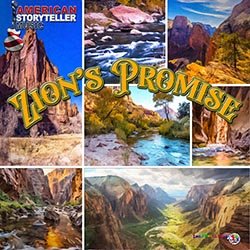
The story behind the song is what happened when I let myself dream Utah instead of just describe it. It shares some of the same country as "Zion's Promise," but this time I wanted to see it all from the air, the way an eagle or a hawk would, and to let the myths the landscape naturally suggests come right to the surface. So a phoenix rises over Zion's canyon walls at sunrise, and the whole red-rock country becomes a place where myth and legend meet.
The eagle and the hawk are the song's real guides. They lift above the human trails and see how the canyons, rivers, and mesas all connect, and they stand for that pull the landscape gives you to rise past your ordinary worries and see your life from higher up. The phoenix belongs to legend the way the birds belong to the desert, and both fit a country that seems to burn without ever being consumed, catching fire fresh with every sunrise and sunset.
I paired flight with water on purpose. The rivers cut downward, carving the canyons deep, while the birds rise above them, and the person standing between the two gets to feel both the depth and the breadth of the place at once. Where "Zion's Promise" is my geological love letter, this one is the dream version, a mythic meditation on freedom, time, and the endless rebirth of stone under the desert light.
Genre:
Cinematic Western folk-rock / atmospheric progressive Americana ballad.
Theme:
Myth and legend meeting real geology, flight and perspective, rebirth and renewal, and freedom against deep time.
Primary Subject:
Southern Utah's canyon country, Zion, Bryce, Arches, and Canyonlands, seen through mythic imagery of eagle, hawk, and phoenix.
Mood:
Soaring, mythic, dreamlike, and reverent.
Core Message:
Seen from the height of an eagle and the fire of a phoenix, Utah's red-rock country becomes a living myth of freedom, rebirth, and elevated vision.
Original Lyrics by M.S. Mckenzie, All Rights Reserved
[Instrumental Intro]
[Verse 1]
Above Zion's mighty canyon walls
Where the phoenix rears its head
Past weeping rocks and hanging falls
In vermilion glory, its wings did spread
Through Narrows carved by virgin streams
Through slots a thousand feet deep
While emerald pools reflect its dreams
In this land where myth and legend meet
[Chorus]
Utah's walls and towers join earth to sky
Displayed In shades of crimson, deep
Where ancient waters have had their way
Through secrets these stones still keep
Under arches drawn against the desert light
Barren mesas as red as blood stand tall
Amidst a maze of painted cliffs on fire
In the land where golden eagles call
[Verse 2]
In Bryce's grand hall of stone
Where hoodoo spirits dance
As if the ancients themselves had to atone
For Time's slow circumstance
And Rainbow Point at breaking dawn
Where a thousand colors come alive
While silent braves stand guard
As the eagle and the hawk wheel and dive
[Verse 3]
Delicate arch bends cautiously
Against the deep blue sky
While balanced rocks defy gravity
And ancient ways still mystify
Those of us who choose to remain
Where the Green and the Colorado meet
Past Island in the Sky's domain
These winding rivers carved so deep
[Chorus]
Utah's walls and towers join earth to sky
Displayed In shades of crimson, deep
Where ancient waters have had their way
Through secrets these stones still keep
Under arches drawn against the desert light
Barren mesas as red as blood stand tall
Amidst a maze of painted cliffs on fire
In the land where golden eagles call
[Final Chorus]
Utah's walls and towers join earth to sky
Displayed In shades of crimson, deep
Where ancient waters have had their way
Through secrets the stones still keep
Past arches drawn against the desert light
Barren mesas as red as blood stand tall
A maze of painted cliffs still catching fire
Of an endless sunset's golden call
Song Description
"The Eagle & the Hawk (Dreams of Zion)" is a sweeping cinematic folk-rock tribute to the monumental landscapes of southern Utah. Moving through Zion, Bryce Canyon, Arches, and Canyonlands, the song combines real geological wonders with mythic imagery, presenting the state's cliffs, hoodoos, arches, mesas, rivers, and desert skies as part of an immense dream unfolding across stone and time.
The song is not simply a geographical tour. Its landscapes possess a symbolic and almost supernatural quality. A phoenix rises above Zion, hoodoos become ancient figures frozen in stone, rivers carve pathways through forgotten ages, and eagles and hawks circle above the canyons like guardians of the high desert. The natural world seems to exist somewhere between physical reality, ancestral memory, and legend.
The title, "The Eagle & the Hawk (Dreams of Zion)," identifies the two birds as central symbols of freedom, perspective, strength, and spiritual vision. Eagles and hawks observe the landscape from far above, seeing relationships between canyons, rivers, mesas, and mountain ranges that remain hidden from people traveling below.
Their flight also represents the emotional response the landscape creates within the narrator. The towering cliffs and open skies inspire a desire to rise beyond ordinary concerns and see life from a broader perspective. The birds are therefore both real inhabitants of the Utah wilderness and metaphors for the human spirit lifted by beauty.
The parenthetical phrase "Dreams of Zion" gives the song an inward and imaginative dimension. Zion is a physical place, but it also becomes a dream state where nature, myth, memory, and wonder overlap. The narrator experiences the whole red-rock region through the emotional doorway opened by Zion Canyon.
The instrumental introduction could begin with a quiet, spacious arrangement that suggests first light entering the canyon. Acoustic guitar, low piano, sustained strings, or a distant electric-guitar line could establish the scale of the landscape before the rhythm section gradually enters.
A soaring violin, flute, or electric-guitar motif could represent the eagle and hawk. This melody might return throughout the song, rising above the main arrangement whenever the birds or open sky become central to the imagery.
The first verse opens above Zion's canyon walls, immediately placing the listener at an elevated viewpoint. The perspective resembles that of a bird circling over the park, looking down into deep river corridors, hanging gardens, pools, and narrow passages.
The phrase "Zion's mighty canyon walls" emphasizes vertical power. These cliffs do not merely surround the landscape; they dominate it. Their height creates the feeling that the visitor has entered a vast natural fortress or temple.
The phoenix rising above the canyon introduces the song's most explicitly mythological symbol. Unlike the eagle and hawk, the phoenix belongs to legend, where it represents destruction, renewal, endurance, and rebirth.
Its presence is especially appropriate in a landscape shaped by continual transformation. Cliffs collapse, rivers cut deeper, waterfalls shift, plants return after disturbance, and changing light seems to make the stone burn and revive each day.
The phrase "where the phoenix rears its head" imagines a rock formation, cloud, flame-colored cliff, or rising bird taking the shape of the mythical creature. Its wings spreading in vermilion glory blend the phoenix with Zion's red and orange sandstone.
The image may also suggest sunrise. As the first light reaches the canyon walls, the stone appears to ignite, allowing the entire landscape to resemble a phoenix emerging from darkness.
The verse then passes Weeping Rock and hanging waterfalls. These delicate flows of water contrast with the enormous sandstone cliffs around them.
The "weeping" rocks give the landscape an emotional character, as though Zion itself remembers the countless ages, floods, droughts, migrations, and lives that have passed through it.
Hanging falls and gardens also reveal how water creates unexpected pockets of life within an arid environment. Where moisture emerges from the cliffs, mosses, ferns, flowers, and other vegetation can flourish.
The phoenix spreads its wings across this vermilion world, joining fire imagery with flowing water. These opposing elements contribute to the dreamlike nature of the verse.
The Narrows then bring the listener down from the canyon heights and into one of Zion's most enclosed landscapes. The Virgin River flows between walls that rise dramatically overhead, narrowing the visible sky to a ribbon of light.
The phrase "virgin streams" plays upon the river's name while also suggesting purity and elemental force. The water appears small compared with the cliffs, yet it is the agent that helped create the canyon.
The slots are described as a thousand feet deep, reinforcing the contrast between the narrow passage below and the immense vertical walls above.
The emerald pools offer a calmer image after the moving river. They reflect cliffs, trees, sky, and perhaps the imagined phoenix itself.
The line "While emerald pools reflect its dreams" makes the mythical bird part of the landscape's inner life. The pools do not merely reflect wings or color. They reflect possibility, rebirth, and the ancient dream of the canyon.
The final line, "In this land where myth and legend meet," defines the emotional character of the entire song. Utah's formations are real and scientifically understandable, yet their shapes continually inspire stories.
Arches resemble gateways. Hoodoos resemble people. Towers appear like castles, temples, or guardians. The physical landscape naturally invites myth because it looks as though it has been designed by forces with imagination and intent.
The chorus expands beyond Zion and presents southern Utah as a unified red-rock kingdom. Walls and towers rise between earth and sky, making the formations appear to connect the human world with the heavens.
The opening line has a strong vertical quality that could support a broad melodic rise. The music should feel as though it is climbing with the cliffs.
The crimson color unites the different parks and formations. Although the region contains cream, white, yellow, brown, gray, pink, and purple, deep red becomes the song's defining visual language.
The phrase "ancient waters have had their way" expresses the patient force responsible for much of the landscape. Rivers, rain, snowmelt, groundwater, and flash floods continually exploit weaknesses within stone.
Water appears soft, but over time it cuts through cliffs, opens canyons, enlarges cracks, and carries entire landscapes away grain by grain.
The stones keep their secrets because they preserve evidence of ancient dunes, vanished seas, uplift, erosion, climate change, human movement, and biological life that cannot be completely reconstructed.
The chorus then moves beneath arches silhouetted against desert light. The wording "under arches drawn against the desert light" creates the feeling that the formations have been sketched upon the sky.
An arch becomes both an object and a frame. Through its opening, the visitor sees distant mesas, mountains, moonlight, or empty blue sky transformed into a natural composition.
The barren mesas standing "as red as blood" introduce a severe and elemental image. Blood suggests life, sacrifice, danger, ancestry, and the living body of the Earth.
The painted cliffs appearing to be on fire continue the phoenix imagery from the first verse. The land itself seems to burn without being consumed.
The final line brings the golden eagle into the chorus as the voice of the region. Its call echoes through the canyons, reinforcing the idea that the desert remains wild and inhabited despite its apparent emptiness.
The eagle may also function as the messenger of the song. From above, it witnesses the entire unfolding story of stone, water, light, and time.
The second verse enters Bryce Canyon, described as a grand hall of stone. This architectural metaphor transforms the hoodoo amphitheaters into an immense gathering chamber.
The formations resemble towers, pillars, statues, and figures standing shoulder to shoulder. Their arrangement gives the impression of an audience assembled within a natural theater.
The hoodoo spirits dance, even though the stone remains physically still. Light and shadow create the illusion of movement as the sun travels across the formations.
At sunrise or sunset, shadows shift rapidly between the hoodoos, making individual figures appear, disappear, lengthen, or lean. The "dance" may therefore be imagined as the choreography of light.
The reference to the ancients having to atone introduces a darker mythic theme. The hoodoos seem like people transformed into stone through punishment, regret, or the passage of time.
This imagery should be understood as poetic fantasy rather than a definitive representation of any particular Indigenous tradition. It gives the formations a haunting human presence while maintaining the song's atmosphere of legend.
"Time's slow circumstance" suggests that transformation does not occur through one dramatic moment. The hoodoos have been shaped gradually through frost, water, erosion, and repeated seasonal change.
The word "circumstance" also implies that their present forms are temporary conditions within a much longer process. Each hoodoo is only passing through one stage of existence.
Rainbow Point at dawn provides the verse with a broad, colorful panorama. Light reaches across the plateau and gradually awakens thousands of formations.
The "thousand colors" are not necessarily separate literal hues but the countless variations created by red, orange, pink, white, gold, blue shadow, and changing atmospheric light.
The phrase "silent braves stand guard" appears intended to describe the hoodoos as courageous or watchful human figures. However, the term "braves" has historically been used as a generalized label for Indigenous men and can sound stereotypical when detached from a specific people or context.
A more neutral and equally powerful alternative might be:
"While silent guardians stand watch"
or:
"While stone-clad sentinels stand guard."
Either version preserves the image of the hoodoos as protective figures without relying on a culturally broad term.
Above them, the eagle and hawk wheel and dive. Their movement contrasts with the stillness of the stone figures below.
The birds are free to rise, descend, and cross the landscape, while the hoodoos remain bound to the plateau. This opposition between flight and stillness becomes one of the song's strongest symbolic relationships.
The eagle often represents majesty and far-reaching vision, while the hawk suggests focus, vigilance, and swift movement. Together, they become guardians of both the physical landscape and its accumulated stories.
The third verse moves into Arches and Canyonlands. Delicate Arch appears to bend cautiously against the sky, emphasizing its seemingly fragile balance.
The word "cautiously" gives the arch awareness, as though it understands how little stone supports its sweeping curve. This personification fits the song's mythic style.
Delicate Arch appears strong enough to frame the sky yet vulnerable enough to remind the visitor that every formation is temporary.
Balanced rocks further challenge the viewer's sense of stability. Their massive upper sections rest upon narrow pedestals, creating the visual impression that gravity has briefly relaxed its rules.
In reality, the formations remain subject to erosion, cracking, and eventual collapse. Their apparent defiance is only temporary.
The verse then introduces "ancient ways," referring to pathways, cultural sites, rock imagery, trade routes, and knowledge of the desert that existed long before modern roads and park boundaries.
These ways mystify modern observers because only fragments of their original meaning remain visible. The physical evidence survives, but the full context may belong to oral traditions and living cultures connected to the land.
The phrase "Those of us who choose to remain" introduces an unusual perspective. It may refer to visitors who remain long enough to listen and reflect rather than simply passing through.
It could also suggest that the landscape asks something of those who stay: patience, humility, respect, and willingness to accept mystery without demanding complete explanation.
The meeting of the Green and Colorado rivers provides the geographical center of the verse. These two waterways join within Canyonlands and continue carving through an enormous system of canyons.
Their confluence is a place where separate journeys become one. Symbolically, it mirrors the song's joining of myth and geology, past and present, earth and sky.
Island in the Sky rises high above the rivers, giving the narrator another birdlike perspective. From its elevated overlooks, the river corridors may appear distant and narrow despite their enormous geological importance.
The phrase "These winding rivers carved so deep" returns the song to the power of water. The rivers are not simply moving through an existing landscape. They are active creators of it.
The second chorus returns with added meaning. The listener has now seen Zion's cliffs, Bryce's hoodoos, Arches' formations, and Canyonlands' rivers.
The walls and towers no longer belong to one location. They form a continuous imaginative realm extending across Utah's red-rock country.
The final chorus changes several lines and moves away from the eagle imagery toward sunset. This shift gives the song a more universal and contemplative conclusion.
"Secrets the stones still keep" replaces "these stones," making the statement broader and more timeless.
"Past arches drawn against the desert light" gives the chorus a sense of continued travel. The narrator is moving through, beyond, and among the formations rather than standing beneath one fixed arch.
The painted cliffs are no longer simply "on fire." They are "still catching fire," emphasizing an ongoing transformation as sunset advances across the landscape.
The final image of an endless sunset's golden call completes the song's movement from the phoenix at sunrise toward fire-colored evening light.
The landscape appears to begin and end in flame, yet the fire is created by illumination rather than destruction. The red-rock country becomes its own phoenix, continually reborn through each cycle of darkness and light.
Musically, "The Eagle & the Hawk (Dreams of Zion)" would work especially well as a cinematic Western folk-rock, orchestral Americana, or atmospheric progressive ballad. Its arrangement should feel expansive, mysterious, and airborne.
The instrumental introduction could begin quietly with acoustic guitar, piano, low cello, and wind-like strings. A high violin or clean electric-guitar melody could enter gradually, representing the flight of the eagle and hawk.
The first verse should remain spacious around the Zion imagery. Reverberant guitar, soft percussion, and sustained strings could create the scale of the canyon walls.
The phoenix line offers an opportunity for a brief instrumental rise. Strings and cymbals could spread outward as its wings appear to open across the cliffs.
The chorus should expand dramatically. Full drums, broad strings, electric guitar, and layered vocals could support the image of Utah's towers joining earth and sky.
The layered vocals might enter in stages, with lower voices grounding the words "walls and towers" and higher harmonies rising around "earth to sky."
The phrase about ancient waters could use a descending melodic line, musically tracing the carving of rivers through stone.
The final line about golden eagles could receive a sustained high harmony or instrumental answer that seems to circle above the main vocal.
The Bryce Canyon verse could use lighter and more intricate instrumentation. Plucked strings, piano, or rhythmic acoustic guitar might suggest the hoodoos' strange dance.
The arrangement could briefly open into silence before the eagle and hawk wheel and dive, allowing the soaring instrumental motif to return.
The third verse should carry more forward motion as the song travels through Arches and Canyonlands. Stronger drums and a wider guitar sound could reflect the scale of the confluence and Island in the Sky.
Two separate instrumental lines could merge beneath the Green and Colorado reference, musically representing the rivers joining.
The second chorus should be broader than the first, while the final chorus should feel more luminous and reflective than purely triumphant.
A final key change or harmonic lift could suit the image of cliffs catching fire in endless sunset, though the arrangement should preserve the song's reverence.
The instrumental outro could return to the eagle-and-hawk theme, played by violin and electric guitar in alternating phrases. The instruments might gradually rise and fade, leaving only wind or a final sustained note.
At its heart, "The Eagle & the Hawk (Dreams of Zion)" is about seeing Utah from the perspective of flight and imagination. The eagle and hawk rise above human pathways, while the phoenix represents the landscape's endless renewal.
The song treats the red-rock country as a place where geological forms naturally become mythology. Cliffs resemble castles, hoodoos resemble assembled figures, arches become portals, and glowing sandstone appears to burn.
This does not diminish the scientific reality of the landscape. Instead, it expresses the emotional response those realities inspire. Rivers did carve the canyons. Frost did shape the hoodoos. Erosion did open the arches. Yet the results seem too strange and beautiful to remain only technical facts.
The song also presents water and flight as complementary forces. Rivers move downward, cutting deep into stone, while birds rise above the resulting canyons. One reveals the depth of the land, and the other reveals its breadth.
The human observer stands between these perspectives, looking down into ancient canyons while looking upward toward circling birds and open sky.
"The Eagle & the Hawk (Dreams of Zion)" is therefore both a Utah landscape anthem and a mythic meditation on freedom, time, and transformation. It celebrates the parks as physical places while allowing them to become symbols of rebirth, mystery, and elevated vision.
Its deepest message is that these landscapes ask us to see beyond the limits of ordinary time. Human lives pass quickly, rivers continue carving, arches slowly thin, and hoodoos rise and fall. Above them, the eagle and hawk continue circling, witnesses to a dream of stone that is ancient, unfinished, and forever changing beneath the desert light.
Songs Associated with
The State of Utah



~ Production Companies ~





~ Production Companies ~
Featured Songs



.jpg)

Leave a Tip