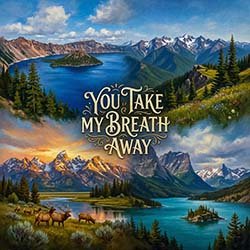
"You Take My Breath Away©"
Release Date: Coming Soon!
Lyrics by M. S. McKenzie | Performed by Songs Across America, Protected by Copyright
~ Associated State Links ~
"You Take My Breath Away"
[Instrumental Intro]
[Verse 1 – Olympic National Park]
Where ancient cedars reach for the rain
And silver rivers wander toward the sea
Through the moss-draped silence of the Hoh
Wilderness awakens something deep in me
From Hurricane Ridge beneath a painted sky
To Second Beach where sea stacks face the spray
I stand where forest, mountain, and ocean meet
And feel the restless world fade so far away
[Pre-Chorus, include in the long version]
Every winding way reveals
A beauty words just can’t convey
It’s in the stillness of a sunrise
That you take my breath away
[Chorus: first line starts slow]
You... you take my breath awayy...
With every mountain rising into the blue...
Oh, You... You take my breath awayy...
With each horizon that comes into view
From forests to canyons
And snowfields to bays
With every step I take…
You take my breath away
Oh yeah... You take my breath awayy…
[Verse 2 – Crater Lake National Park]
Nestled neatly in the midst of the Cascades
Lies a lake that’s bluer than an autumn sky
Born of fury then softened by time
A wondrous spectacle for every eye
Wizard Island rises like an impossible dream
While pillars of basalt guard every shore
I gaze into those hues of azure blue
And find myself believing in more
[Chorus: first line starts slow]
You... you take my breath awayy...
With every mountain rising into the blue...
Oh, You... You take my breath awayy...
With each horizon that comes into view
From forests to canyons
And snowfields to bays
With every step I take…
You take my breath away
Oh yeah... You take my breath awayy…
[Instrumental Interlude]
[Soft electric keyboard carries the chorus melody while Strings and electric piano gradually swell]
[Verse 3 – Grand Teton National Park]
First light turns Tetons’ peaks crimson
While a mist is drifts over Jackson Lake
Mountains rise like mighty cathedrals
As a rising sun causes each peak to wake
Along the Snake River, cottonwoods glow
And granite spires reach towards heaven
As elk move in and out of shadow far below
And a bald eagle soars high over paradise
[Verse 4 – Glacier National Park]
On Going-to-the-Sun Road one morning
I climbed above every valley and stream
Where glacial peaks stood fast against the dawn
Like sleeping giants waking from a dream
And Saint Mary’s waters held the mountains
While wildflowers crowded every alpine way
And there… in the silence of that moment
My heart had found the words it needed to say
[Bridge]
These lands belong to every generation
A living promise we are called to keep
May we protect their beauty and their freedom
The rivers wide—the forests dark and deep
For every child who dreams under starlight
For every soul still searching for a way
May these wild places stand through the ages
And always take our breath away
[Final Chorus]
You... you take my breath awayy...
With every mountain rising into the blue...
Oh, You... You take my breath awayy...
With each horizon that comes into view
From Olympic’s rugged coastline
To Crater Lake’s eternal blue
From the Tetons in the morning
To Glacier’s grandest view
You take my breath away
You take my breath away
Oh, you take my breath away…
Ohhhh, you take my breath awayyyyy
Oh, you take my breath away…
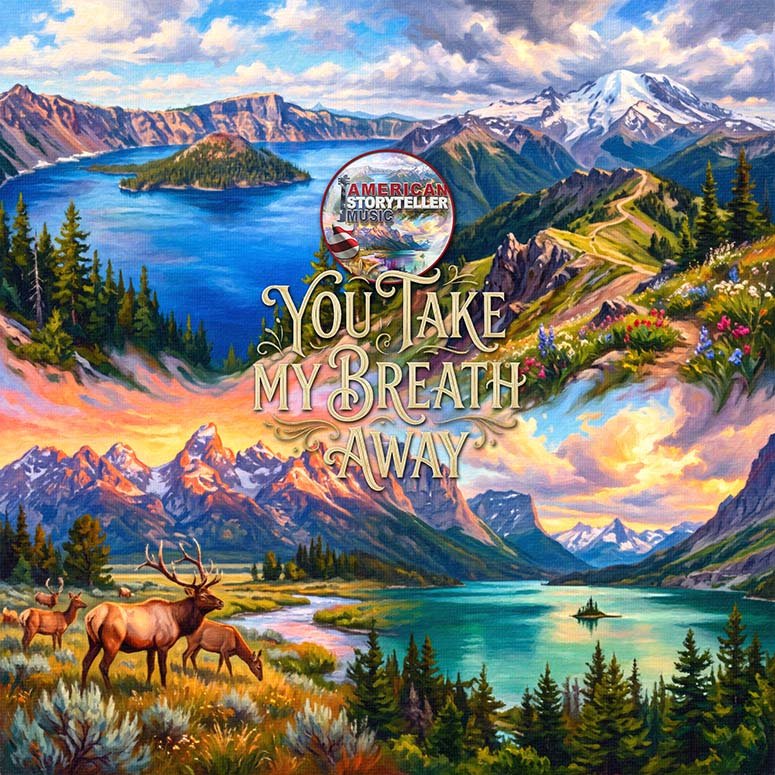
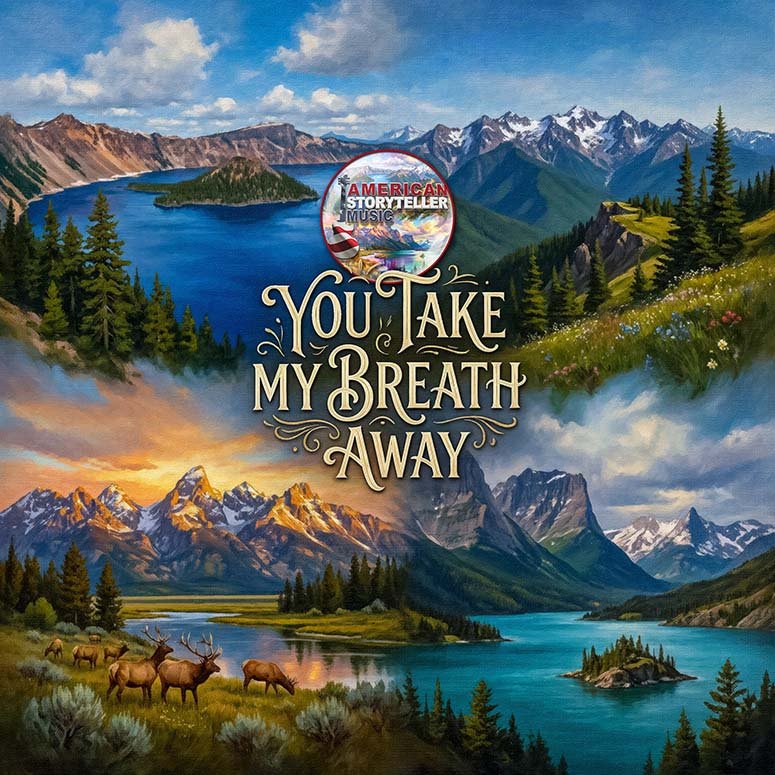
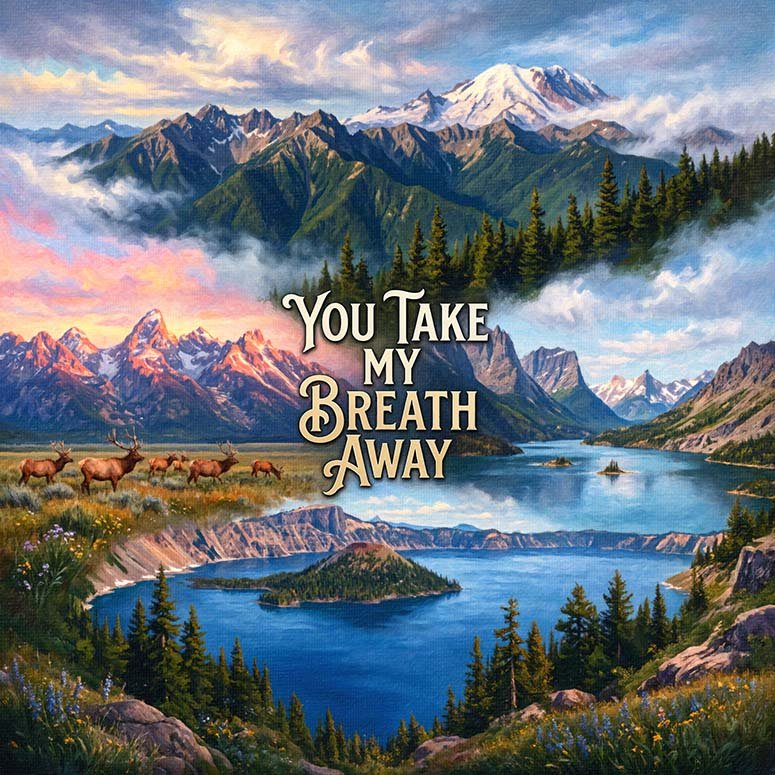
“You Take My Breath Away” is a sweeping adult contemporary and soft pop-rock tribute to the overwhelming natural beauty of America’s national parks. Moving through Olympic, Crater Lake, Grand Teton, and Glacier national parks, the song captures the sense of wonder that comes from standing before landscapes so vast, ancient, and beautiful that ordinary language seems inadequate. Its central phrase, “you take my breath away,” becomes more than a romantic expression. It is transformed into a declaration of awe directed toward the mountains, forests, lakes, rivers, coastlines, and wild places that define the American landscape.
The song begins in Olympic National Park, one of the most geographically diverse protected landscapes in the United States. The opening verse moves from the ancient rainforests of the Hoh to the alpine heights of Hurricane Ridge and the rugged Pacific shoreline at Second Beach. These locations represent Olympic’s extraordinary meeting of ecosystems, where temperate rainforest, snow-covered mountains, rushing rivers, and ocean coastline exist within the same great wilderness. The “ancient cedars” reaching toward the rain and the “moss-draped silence of the Hoh” establish an almost enchanted atmosphere. The forest feels alive with memory, while the silver rivers wandering toward the sea suggest the continual movement connecting the mountains to the Pacific Ocean.
The second half of the first verse expands the view from the rainforest to Hurricane Ridge and Second Beach. The line describing the place “where forest, mountain, and ocean meet” summarizes the remarkable character of Olympic National Park. It is also the first major emotional turning point in the song. The narrator does not simply observe the scenery but experiences a release from everyday concerns. Surrounded by the scale and stillness of the park, “the restless world” begins to fade away. Olympic becomes a place of restoration, where the pressures and noise of ordinary life temporarily lose their hold.
The optional pre-chorus deepens this feeling of discovery. “Every winding way reveals / A beauty words just can’t convey” suggests that the experience unfolds gradually, around each bend in a trail or mountain road. The beauty cannot be fully summarized in photographs, maps, or descriptions. It must be encountered directly. The final lines of the pre-chorus introduce the song’s central hook by connecting breathless wonder with the stillness of sunrise. Rather than arriving through excitement alone, the moment comes quietly, when the landscape is calm and the observer is fully present.
The chorus opens dramatically, with the first “You” held slowly and allowed to rise above the accompaniment. This creates a moment of anticipation before the melody expands into the title phrase. The delivery should feel suspended, as though the singer is pausing to take in the view before finding the words to describe it. The elongated pronunciation of “away” gives the hook an open, soaring quality appropriate for a song about immense mountains and distant horizons.
Although the title might initially suggest a conventional love song, the chorus quickly reveals that the object of affection is the natural world. Mountains rise into the blue, new horizons come into view, and the narrator travels through forests, canyons, snowfields, and bays. Each environment offers a different expression of beauty, yet all create the same emotional response. The repeated phrase “with every step I take” also gives the song a personal, experiential quality. This is not simply admiration from a distance. The narrator is walking through these landscapes, climbing roads and trails, standing beside lakes, and becoming part of the experience.
The second verse travels south through the Cascades to Crater Lake National Park. Here, the song shifts from Olympic’s interconnected ecosystems to the concentrated wonder of a single extraordinary landscape. Crater Lake is introduced as something almost hidden within the mountains, “nestled neatly in the midst of the Cascades.” This creates a sense of discovery, as though the traveler has arrived at a secret world concealed within the volcanic highlands of southern Oregon.
The description of the lake as “bluer than an autumn sky” emphasizes its famous color and clarity. The next line, “Born of fury then softened by time,” compresses Crater Lake’s dramatic geological history into a poetic image. The peaceful lake occupies the remains of an enormous volcanic eruption, creating a contrast between violent beginnings and present-day serenity. What was once an event of destruction has become one of the most beautiful and contemplative places in the country.
Wizard Island rises from the lake “like an impossible dream,” adding a surreal quality to the scene. The basalt formations guarding the shore make the caldera feel like a protected natural sanctuary. As the narrator gazes into the lake’s azure depths, the experience becomes spiritual and emotional without being tied to a particular religion. The line “I find myself believing in more” suggests a renewed belief in possibility, beauty, endurance, and the meaningfulness of the natural world. Crater Lake does not merely impress the traveler; it expands the traveler’s imagination.
After the second chorus, the instrumental interlude allows the listener to absorb the journey so far. A soft electric keyboard carrying the chorus melody maintains the song’s emotional continuity, while strings and electric piano gradually swell beneath it. This section can evoke the sensation of traveling between parks, with changing scenery passing beyond a car window. The arrangement should remain warm and reflective, slowly gathering scale as the song prepares to enter the grandeur of the Rocky Mountain West.
The third verse opens at Grand Teton National Park during first light. The Tetons are introduced through color and motion as their peaks turn crimson and mist drifts across Jackson Lake. The imagery gives the impression of a landscape awakening. At sunrise, the mountains do not appear static. They seem to rise out of darkness and come alive beneath the changing sky.
The comparison of the mountains to “mighty cathedrals” expresses their towering, reverent presence. Their steep granite walls and sharply defined summits create a form of natural architecture that inspires silence and humility. The sunrise becomes almost ceremonial as it reaches one peak after another. This is one of the song’s clearest expressions of nature as a place of contemplation, where grandeur itself creates a sense of reverence.
The view then widens along the Snake River, where glowing cottonwoods soften the granite intensity of the mountains. Wildlife moves quietly through the scene as elk pass between sunlight and shadow and a bald eagle circles above. These details prevent the verse from becoming only a panoramic landscape description. The park is presented as a living ecosystem filled with movement, migration, and interconnected life. The eagle soaring above “paradise” completes the image of freedom and wilderness, while also connecting the scene to a broader American identity.
The line “While a mist is drifts over Jackson Lake” would likely be sung more smoothly as “While a mist drifts over Jackson Lake.” This small correction preserves the meaning while improving the grammar and natural vocal flow. Similarly, the final line of the verse could be strengthened rhythmically if the melody requires a slightly more balanced syllable count, although its image of the eagle soaring above paradise is clear and effective.
The fourth verse continues north to Glacier National Park. The journey begins on Going-to-the-Sun Road, one of the most celebrated scenic mountain roads in America. The narrator climbs above valleys and streams as glacial peaks emerge in the morning light. The upward movement creates a feeling of ascent, both physically and emotionally. Each turn of the road reveals a larger world, carrying the traveler from the forested lower valleys into the open alpine heights.
The mountains are compared to “sleeping giants waking from a dream,” giving them a timeless and almost mythic presence. This image is especially effective at dawn, when shadows withdraw from the peaks and sunlight gradually reveals their immense forms. The mountains seem ancient and enduring, yet the changing light makes them appear newly awakened.
Saint Mary Lake reflects the surrounding mountains, creating a second version of the landscape within the water. The alpine wildflowers bring color and delicacy to the massive scale of rock, sky, and ice. The contrast between fragile flowers and monumental peaks captures one of Glacier’s defining qualities. Immensity and intimacy exist side by side.
The final lines of the verse provide the song’s most direct transition from observation to expression. In the silence of the moment, the narrator’s heart finally discovers what it has been trying to say. The phrase “you take my breath away” is therefore not merely a catchy chorus. It is the emotional conclusion reached through the entire journey. The landscapes have gradually stripped away distraction until only wonder remains.
The bridge expands the song beyond personal admiration and introduces its conservation message. These parks are described as belonging to “every generation,” emphasizing that they are a shared inheritance rather than the possession of one person, region, or period of history. The phrase “a living promise we are called to keep” presents preservation as an active responsibility. The parks survive not through admiration alone, but through continued protection, stewardship, and public commitment.
The bridge also recognizes that national parks are more than scenic destinations. They are refuges for wildlife, watersheds, forests, cultural landscapes, places of learning, and sources of inspiration. The rivers and deep forests represent ecological continuity, while the children dreaming beneath starlight symbolize generations that have not yet experienced these places. The song asks listeners to consider what kind of natural world will be passed forward.
“For every soul still searching for a way” adds another emotional dimension. Wild places can offer perspective to people who feel overwhelmed, uncertain, or disconnected. They cannot solve every human problem, but they can create stillness, humility, and a renewed sense of belonging within something larger. The hope that these places will “stand through the ages” transforms the bridge into both a promise and a plea.
The final chorus brings all four parks together in a single panoramic conclusion. Olympic’s rugged coastline, Crater Lake’s eternal blue, the Tetons at morning, and Glacier’s grand mountain vistas represent four distinct expressions of American wilderness. By naming them in succession, the song creates the feeling of a musical travelogue reaching its destination. The listener has crossed rainforests, volcanic highlands, river valleys, alpine roads, coastlines, and mountain ranges.
The repeated title lines at the end allow the emotional theme to linger after the geographical journey is complete. Each repetition can grow in intensity, supported by expanding strings, sustained electric guitar, layered harmonies, and a fuller rhythm section. The final extended “away” should feel expansive rather than forceful, suggesting an open horizon that continues beyond the end of the song.
Musically, “You Take My Breath Away” is well suited to a late-1970s or early-1980s adult contemporary sound, combining soft rock warmth with cinematic orchestration. A gentle electric piano or keyboard can introduce the central melodic figure, followed by clean electric guitar, warm bass, restrained drums, and subtle strings. The verses should remain spacious enough for the landscape imagery to remain clear, while the choruses should open into a broader, more soaring arrangement.
The vocals should communicate sincerity and wonder rather than excessive theatricality. The singer is not performing above the landscape but responding to it. A warm lead vocal, supported by carefully placed harmony lines, would allow the chorus to become memorable without losing the reflective quality of the verses. The final chorus could introduce higher harmonies, a stronger snare, fuller strings, cymbal swells, and sustained guitar notes to create a sense of emotional arrival.
At its heart, “You Take My Breath Away” is a love song addressed to the American wilderness. It celebrates four national parks not merely as famous attractions but as places capable of changing how people see the world and themselves. Olympic awakens wonder through diversity, Crater Lake reveals beauty born from geological upheaval, Grand Teton offers the majesty of mountains at sunrise, and Glacier provides a final vision of alpine grandeur and timelessness.
The song’s deeper message is that awe should lead to gratitude, and gratitude should lead to protection. These landscapes take our breath away because they remain wild, expansive, and alive. By preserving them, each generation ensures that future travelers will be able to stand beneath the same mountains, beside the same waters, and under the same starlit skies—and experience that same unforgettable moment when beauty leaves them without words.




















.jpg)