"The Muse©"
Lyrics by M. S. McKenzie (Unless Otherwise Noted) | Music Performed by Songs Across America or American Storyteller Music, All Songs Are Protected by ©
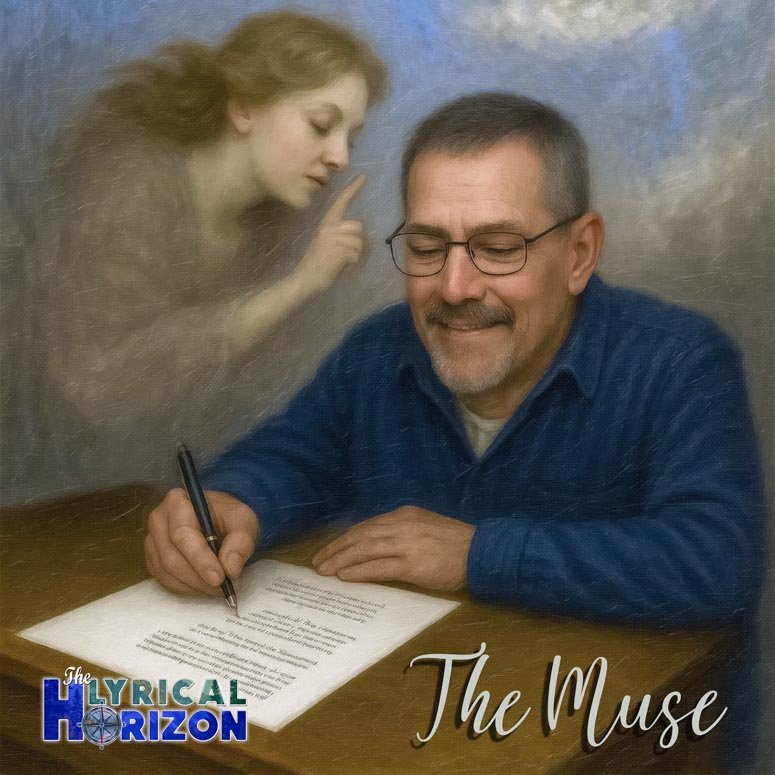
"The Muse"
I wrote "The Muse" from the feeling that someone can leave this life without ever completely leaving us. There are people whose love becomes woven into the way we think, create, and find the strength to continue. Long after they are gone, their presence can return in a quiet room, an unexpected memory, a familiar phrase, or a melody that seems to arrive from somewhere beyond us. The story behind the song is not only about grief. It is about the strange and comforting possibility that love can continue to guide us even when the person who gave us that love can no longer walk beside us.
I wanted the song to move honestly through the darker side of loss without remaining there. The early verses reflect those lonely moments when time seems to move forward while part of the heart remains behind. As the song develops, sorrow slowly gives way to reassurance. The person who is gone becomes an inner voice, a source of strength, and perhaps even the unseen hand guiding the narrator's ship toward peaceful waters. The muse is both a dearly missed person and the lasting inspiration that person left behind.
Although Songs Across America often celebrates physical places, landscapes, and journeys, I also believe that some of our most important journeys take place within the human heart. Not every river we cross appears on a map, and not every guiding light can be seen. I hope listeners hear something of their own lives in "The Muse," especially those who have lost someone whose influence remains with them. Above all, I hope the song reminds them that grief and gratitude can exist together, that memory can become a source of strength, and that the love we receive may continue shaping our lives, our art, and the people we become.
Enduring love, grief, remembrance, spiritual connection, artistic inspiration, healing, and the lasting influence of someone who has passed away.
Primary Subject:
A departed loved one whose memory remains the narrator's muse, inner companion, and source of emotional and creative guidance.
Mood:
Intimate, mournful, reflective, tender, spiritual, comforting, and quietly hopeful.
Love does not necessarily end with physical separation. The memory, influence, and emotional presence of someone we have lost can remain within us, guiding our choices, inspiring our creativity, and helping us find peace through even the darkest periods of life.+
[Verse 1]
In the quietest of moments, I whisper your name (your name)
I wonder if you might be near, I wonder if you are still the same (the same)
These lonely nights grow longer. I wonder why the stars still shine above
I look into every face, yet nothing fills the space of your love (your love)
[Pre-Chorus]
I wander through these silent rooms, your voice I chase
A gentle whisper on the breeze, a warm embrace
The time moves forward at a much quicker pace...
...but the memories of you still stay
They guide me gently, day after day
[Chorus]
I often wonder if you are by my side
In those darkest of times, do our hearts collide
In every song I write, do you speak to me
Are your words present in this melody
I often wonder if you are watching, if you can see
Even though you're gone...
...you still mean the world to me
[Whispered: female voice]
...you mean the world to me
[Verse 2]
For every river that I have ever crossed
Some days I look back and I think of what I've lost
Yet in my lonely heart, I always feel you're near...
...I feel you here (feel you here)
Remembering the sad times when I wanted to cry
Sometimes I felt like I could die (I could die)
[Bridge]
Maybe you're dancing among the stars,
Holding my hand, wherever you are.
Every breath, every tear I cry,
Tells me our bond will never die.
[Verse 3]
But then a comforting thought would wash over me
A powerful thought that would set my spirit free
...set my spirit free!
A comforting thought from another realm...
...Is this you at the helm?
Guiding my ship into peaceful waters
[Pre-Chorus]
I wander through these silent rooms, your voice I chase
A gentle whisper on the breeze, a warm embrace
The time moves forward at a much quicker pace...
...but the memories of you still stay
They guide me gently, day after day
[Chorus]
I often wonder if you are by my side
In those darkest of times, do our hearts collide
In every song I write, do you speak to me
Are your words present in this melody
I often wonder if you are watching, if you can see
Even though you're gone...
...you still mean the world to me
[Whispered: female voice]
...you mean the world to me
...you will always mean the world to me
“The Muse” is an intimate, slow-burn ballad that traces the lingering gravity of a lost:but ever-present:love. Lyrically, it sits at the twilight border between memory and afterglow: the narrator drifts through silent rooms, scanning night skies and crowded streets for fleeting proof that the one who once inspired every heartbeat is still close in some unseen dimension. Each verse unspools gentle, conversational confessions (“I whisper your name… I look into every face”) while the recurring pre-chorus turns those private musings outward, letting the listener feel time accelerating even as emotions stand perfectly still.
Musically, imagine a 72 BPM pocket in A minor that blossoms into C major for the choruses:an understated shift that mirrors the song’s movement from ache to uplift. A solitary piano introduces Verse 1, washed in cathedral-like reverb so every keystroke feels suspended in air. Subtle finger-style acoustic guitar and a breathy pad swell in the pre-chorus, then a spacious rhythm section (soft kick, brushed snare, gentle bass pulses) anchors the chorus without breaking its fragile intimacy. In the background, a halo of legato strings enters on the second verse, rising to a cinematic shimmer beneath the bridge where the lyrics picture two souls “dancing among the stars.”
Vocally, the performance calls for a tender, almost confessional male (or gender-flexible) lead, sung close to the mic to capture every quiver of doubt and hope. Between the lines:and especially on the whispered tags:an ethereal female voice slips in like a spectral echo of the muse herself, doubling key phrases or rustling through the stereo field. The whispered refrain “…you mean the world to me” functions as both a ghostly caress and a sonic signature, best delivered with intimate panning and a touch of delay.
Dynamics evolve organically: verses float on sparse instrumentation; the first chorus lifts with warm low strings and light cymbal swells; the bridge reaches the emotional apex with swelling harmonies and a luminous, reverbed guitar motif. After the final chorus, the arrangement should exhale back to piano and pad, allowing the last whispered line “…you will always mean the world to me” to fade into silence like a candle’s final glow.
Imagery runs throughout: stars that “still shine above,” unseen hands guiding a “ship into peaceful waters,” and whirling memories that “guide me gently, day after day.” These motifs reinforce the central idea that love, once kindled, continues to illuminate even the darkest corridors of absence.
Overall, “The Muse” bridges soft-rock and adult-contemporary sensibilities:think the reflective warmth of early Coldplay or Damien Rice, blended with the atmospheric hush of Sarah McLachlan. Its emotional arc moves from solitary yearning to quiet reassurance, making it ideal for late-night playlists, memorial montages, or any moment when a listener needs to feel that love can survive separation and time. For your Songs Across America project, the track slots naturally into the “Optimistic Humanism” thread: it mourns what is gone while celebrating the enduring spark that keeps art:and hearts:alive.





























.jpg)